An Opinionated Guide on Getting to the Interview Stage
Back in January, I put an open call on LinkedIn.
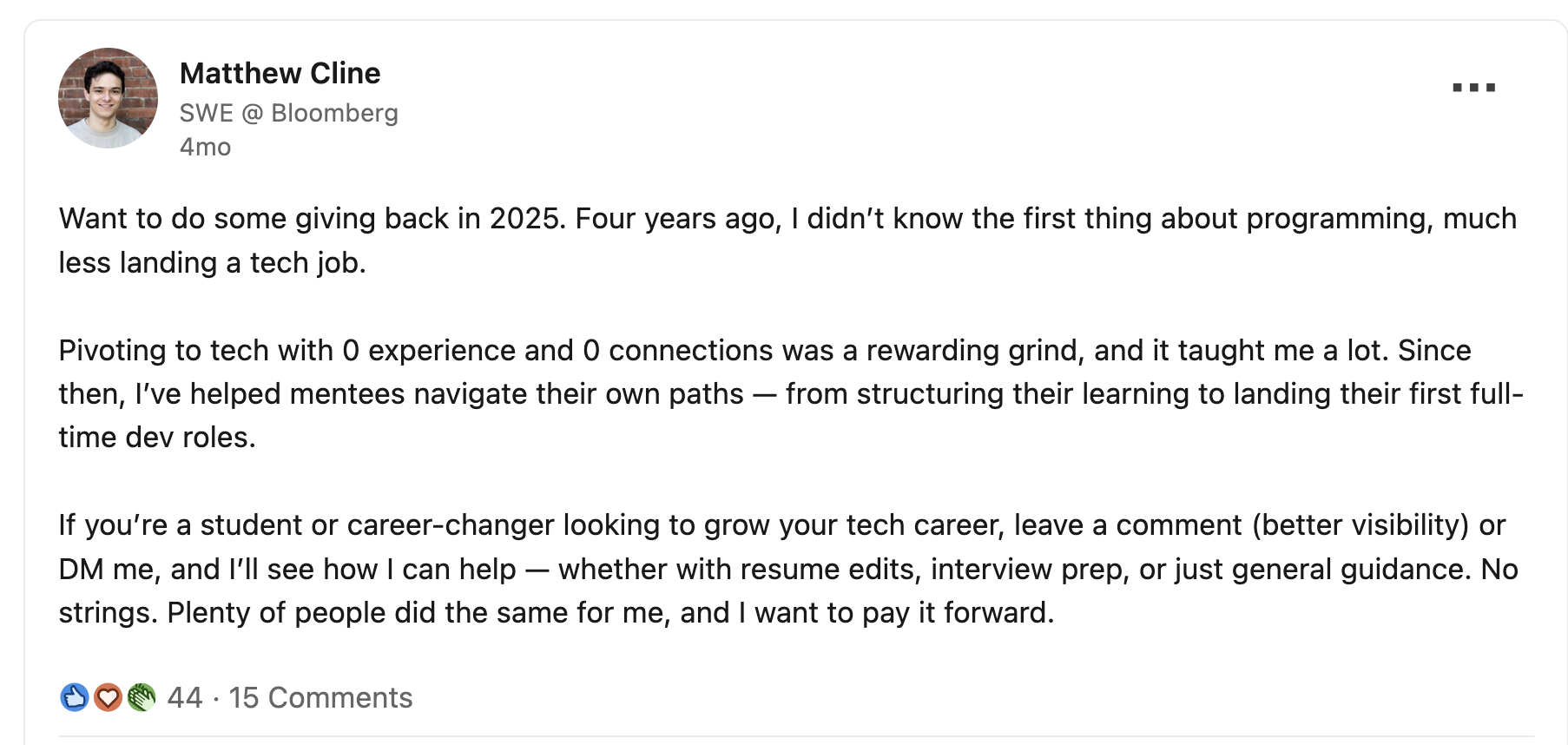
One respondee shared that they were having problems even getting an interview and asked my advice. Below is my reply.
Hello [name]!
Here are some thoughts on getting to the interview stage.
First of all, you are correct to think of this process in two stages. From the moment you first make contact with a real human being at a company, your resume pretty much ceases to matter. Your interview performance is the only thing that counts from then on. So as a preamble: make sure you are ready for the interviews. This means having answers on deck for common behavioral questions (you can Google these) and knowing how to manage the clock well (it is so easy to go overlong when answering these questions. I literally timed myself when practicing). Most tech jobs are going to ask Leetcode style questions. The best free resource out there right now is neetcode.io. I’ll leave it at that for now since this wasn’t really your question.
Getting to the interview stage requires a super polished resume. Some guideposts here: don’t reinvent the wheel. This resume isn’t an outlet for creativity or individuality. Find a simple template online and use it (I like using LaTeX for my resume). No colors. There should be sections for education, languages + technologies (there are different ways to word this), professional experience, and personal projects (open source contributions go here). It must be a single page. I’m not generally a fan of a summary section but in your case, it could make sense since your background is a bit unique and your interests are specific. Beyond this basic skeleton, a couple pieces of advice apply.
The average hiring manager will spend seven seconds reviewing your resume (this has been studied with eye tracking software and everything). Thus, it is helpful to optimize your resume for skimmability. In practice, this means two things:
-
include quantifiable metrics in your accomplishment bullet points. The point here is to be helpful to the recruiter, to help them contextualize your work. A perfect example is one of your LinkedIn bullets “Reduced customer costs by 20 contractor hours…” That’s great. Even better if you can make the leap to measuring it in dollars. Estimation is fine. Let’s say a contractor costs a customer $50/hour. Then you can also say “Reduced costs by $1,000” or even “$X,000” if you’d prefer to keep it vague.
-
Don’t clutter your bullets with technical jargon. A lot of people make this mistake with bullets that look like “implemented a python Fast API REST with telemetry monitoring logging testing OpenAI springboot kubernetes clustering with latency throughput analysis.” It is just impossible to extract any salient meaning from that. Keep it focused on the impact of what you did, not just the actions you took. Maybe include 1 or 2 technical buzzwords at most. But in general, the “technologies and frameworks” section is where to do your laundry listing. In general, the audience for your resume is nontechnical.
Re: referrals. They are worth seeking. I see you went to [uni1] and [uni2], those are both big schools who have alumni at big tech companies. Message them. Ask to talk if that’s what you want, ask for a referral straight up if you want. Most will ghost you. Some will say yes. Nobody will be rude or mean though. The biggest point is to respect their time. Explain who you are and what your qualifications are, link to the job you’re interested in, be polite and appreciative. Respect their time with concision.
Crucially, a referral must happen before you submit your app to have any effect.
Finally, this is a bit of a numbers game. You should be applying for five jobs a day. Your inbox should be littered with job postings. Make a separate email address for them all if you have to. But if you turn over every stone, it will shock you how many listings are out there. Five a day takes you to ~500 apps in three months. That is a number I’d feel good about. But this is a minimum, apply to anything you see. And as mentioned above, be ready when the time comes.
A final rehash of what I said above: you should have a solid, ready-to-go answer for “why the pivot to CS,” “why the career break,” “why not physics,” etc. You can see those questions coming. You don’t have to make people believe you can walk on water with these answers. You only need to put them at ease and show that you’re a self-assured, talented person who they’d like to work with.
That about does it! Let me know if anything isn’t clear. Shoot me your resume once you’ve had a chance to work some of this in if you’d like. And good luck!
Matt
Epilogue:
This person and I exchanged 11 emails over weeks, edited multiple iterations of their resume, and in March, they landed an engineering role at a local startup.
Lfg.
PS: I really do enjoy giving back and helping others on their journeys. Should anyone stumble across this and think they could benefit from a conversation, reach out.